

The Prehensile Paw: A Biomechanical Deconstruction of the Phu Quoc Ridgeback's Dexterity
- Phu Quoc Ridgeback Kennel Club

- Oct 23, 2025
- 5 min read

Within the rich tapestry of canine biodiversity, certain breeds emerge not merely as companions, but as profound testaments to the power of adaptive evolution. The Phu Quoc Ridgeback, an indigenous canine of Phu Quoc Island, Vietnam, is one such specimen. While its eponymous dorsal ridge—a strip of fur growing in reverse direction along the spine—often commands initial attention, it is a far more nuanced anatomical feature that truly defines its exceptionalism: the highly specialized structure of its pes (hind foot) and manus (forefoot). To the astute observer, the paws of the Phu Quoc dog are not mere instruments of locomotion; they are sophisticated biomechanical systems engineered for grip, stability, and a degree of manipulative control that verges on the prehensile.
This article provides a detailed morphological and functional analysis of these remarkable structures, positing that the Phu Quoc's unparalleled agility is a direct consequence of an evolutionary refinement of the standard canine paw, resulting in a multifunctional grasping organ.
I. The Hallux as a Fulcrum: Re-evaluating the Canine Dew Claw
In most canids, the dew claw—anatomically known as the hallux or first digit—is a vestigial and functionally obsolete structure. Positioned high on the metacarpus or metatarsus, it typically makes no contact with the substrate and is often surgically removed to prevent trauma. In the Phu Quoc Ridgeback, however, we observe a radical departure from this norm.
The Phu Quoc's hallux is a robust, fully articulated digit, situated lower on the limb and possessing a well-developed, often large, ungual process (claw). Its functional integration into the weight-bearing and propulsive mechanics of the foot is profound. One can conceptualize its role through two primary analogies:
The Crampon Pick: During traversal of irregular, inclined, or unstable terrain—such as the rocky escarpments and moss-slickened logs of its native island—the hallux (dew claw) engages the substrate. This provides a critical fifth point of anchorage, drastically increasing the paw's surface area and preventing supination or pronation (twisting) of the limb. This is not a passive feature; it is an active participant in stability.

The Climber's Hook: In arboreal locomotion, a behavior exceptionally rare among canids, the hallux becomes a primary tool. The dog can actively flex this digit to hook it into bark fissures or around branches, generating significant tensile force to hoist its body mass vertically. This transforms the limb from a purely columnar, weight-supporting structure into a hybrid appendage capable of both propulsion and suspension.
The presence of a functional, weight-bearing hallux is a quintessential example of island adaptation, where selective pressures favored individuals with enhanced traction and climbing prowess for hunting and survival.

II. Articular Hyperflexion: The Phalanges as a Dynamic Grasping Mechanism
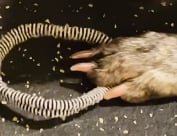
Beyond the specialized hallux, the digital skeleton itself exhibits remarkable adaptations. The phalanges of the primary digits (II, III, IV, and V) demonstrate an exceptional range of motion, particularly in the metacarpophalangeal and interphalangeal joints. This permits a degree of palmarflexion (downward curling) and cupping far exceeding that of typical domestic dogs.
This "articulate foot" allows the paw to conform with intimate precision to the geometry of a given object or surface. The functional implications are twofold:
Enhanced Friction and Weight Distribution: When navigating a rounded or slippery surface, such as a wet rock or tree limb, the ability to cup the paw maximizes the contact area of the digital and metacarpal pads. This creates a superior frictional interface and distributes ground reaction forces more evenly, mitigating the risk of slip.

Manipulative Precision: This is not a blunt, pincer-like grip. The independent flexion at each joint allows for a delicate, almost hand-like manipulation of objects. A Phu Quoc Ridgeback can hold a bone, a ball, or even a human arm with a controlled, deliberate pressure that suggests a level of neurological fine-tuning coordinating the flexor and extensor muscle groups of the forearm. This dexterity points to a sophisticated level of proprioception—the sense of the relative position of one's own body parts—in the extremities.




III. A Hybrid Traction System: The Semi-Retractable Ungual
The canine and feline families typically represent two divergent evolutionary strategies for managing the ungual (claw). Canids possess perpetually extended claws, optimized for endurance running and digging, while felids have fully retractable claws, preserving their sharpness for capturing prey. The Phu Quoc Ridgeback once again defies simple categorization, occupying a unique middle ground with its semi-retractable claw mechanism.
While the precise anatomical structures enabling full retraction in cats (specifically the dorsal elastic ligament) are not fully replicated, the Phu Quoc exhibits a degree of passive retractability. The claws are maintained in a partially protracted state, but they are not subject to the constant abrasive wear of a typical dog's claws on hard surfaces. This hybrid system confers distinct advantages:
Maintained Sharpness: The claws remain notably sharper and more curved than those of a ground-wearing breed. This preserved acuteness is critical for the "grip-and-rip" mechanics of high-speed directional changes and for penetrating fibrous materials like tree bark during climbing.
Constant Traction Readiness: Unlike a cat that must consciously extend its claws, the Phu Quoc's are perpetually "at the ready." This provides instantaneous traction for explosive acceleration, a crucial asset for a cursorial hunter. During high-velocity turns—the proverbial "turning on a dime"—these sharp, semi-protracted claws act like the studs on a football cleat, digging into the substrate to generate immense lateral ground reaction forces, thereby enabling rapid changes of direction with minimal loss of kinetic energy.

IV. Synthesis in Motion: An Integrated Biomechanical System
The true genius of this design lies not in the individual components, but in their synergistic integration. The Phu Quoc paw is a holistic system where the hallux, the articulate phalanges, and the semi-retractable unguals function in concert.
Consider a hypothetical sequence of hunting behavior:
The Pursuit: The dog gallops across uneven forest floor. The semi-retractable claws provide primary traction, while the hallux intermittently contacts raised obstacles, providing micro-corrections in stability.
The Ascent: Prey escapes into a tree. The dog approaches the trunk. The articulate phalanges allow the paws to initially conform to the bark's contour. Simultaneously, the sharp claws and the robust hallux engage, hooking into imperfections to initiate a powerful, pulling ascent that leverages the entire forelimb musculature.
The Pivot: Should the prey leap to an adjacent branch, the dog must reorient itself. Planting a forefoot, the hallux anchors, the toes splay to maximize the base of support, and the claws bite deep. The combined system creates a stable, quasi-tripodal fulcrum (the primary pad plus the hallux) from which the animal can torque its body with astonishing agility.
This integrated functionality also extends to swimming, where the webbed feet, a common trait, are enhanced by the ability to splay the digits widely, effectively increasing the paddle surface area for more powerful and efficient strokes.
V. Conclusion: A Paradigm of Adaptive Morphology
The Phu Quoc Ridgeback offers a compelling case study in how isolation and specific environmental pressures can drive the radical specialization of a common anatomical structure. Its paw is a masterwork of evolutionary engineering, a single unit that combines the constant traction of a canine, the sharp, preserved weaponry of a felid, and the grasping capability of an arboreal mammal.
To dismiss these features as mere curiosities is to overlook a profound biological narrative. The Phu Quoc's dexterous paws are a direct materialization of its environment—a solution written in bone, tendon, and keratin to the challenges of a rugged, three-dimensional island landscape. In studying this wonderful breed, we are reminded that evolution is the ultimate innovator, often refining the mundane into the extraordinary, placing a tool of immense capability and grace at the very tips of its creations.
*****
To learn more about the Phu Quoc ridgeback dog, come join the Phu Quoc ridgeback community on facebook:
Special thanks to Dr Dania Richter and Báo-Đen in Germany for providing us with the wonderful photos and footages of the black beauty, Báo-Đen, and of course to our handsome pawsome model, Golden Boy Gohan, and his Mom Pauline Ly in Los Angeles, CA.


Comments